Amati Swedish Gunboat Build – Part 6

Member Clare Hess posts his latest update on building (and modifying) Amati’s Swedish Gunboat kit. This is a small, inexpensive kit that is short on instructions. Not ideal for beginners, but a nice kit for experienced ship modelers looking for a simple project.

Ship Modeler

Following our meeting in October, it was clear it was time to finish up the Swedish Gunboat build. We’re down to three active builders of this model from the five that started, which isn’t too bad. One of our  builders decided to finish his up as a gift for someone, and the other is a beginning ship modeler who is anxious to get to his next project. I’m also ready to have a project actually reach completion.

Rigging and Sails

I shaped the masts and the two lugsail yards some time back. I originally added a ball to the tops of the masts as shown on the kit plans, but replaced them with a thinner pole after looking at the photos of the museum model. The presence of the pole creates a shoulder at the top of the mast, that helps secure the shrouds and stays. While modifying the masts…

View original post 804 more words

HSPMS Newsletter and Meeting – February 2017

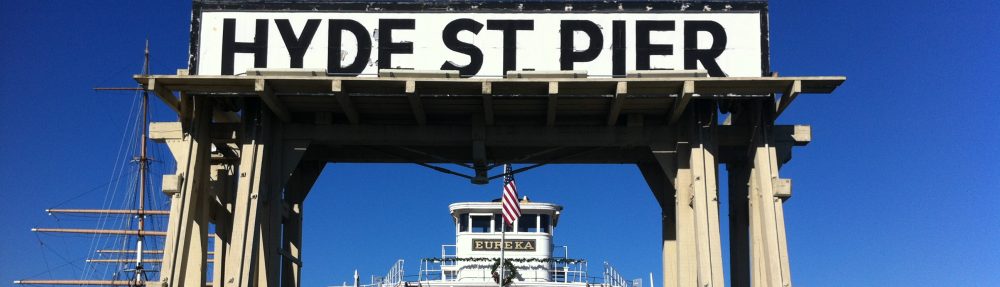
The next meeting of the Hyde Street Pier Model Shipwrights is coming up quickly, Saturday, February 18th aboard the ferryboat Eureka.

Naturally, the sunny weather we’ve been enjoying in the San Francisco Bay area is coming to an end, and the forecasts call for a couple days of rain. However, they show a break in the weather on the weekend. Let’s hope they’re correct!

img_3413

Models from the January meeting.

In the meantime, here’s the latest issue of the Hyde Street Pier Model Shipwrights Newsletter for February for your reading enjoyment.

Click to access hyde-street-2017-02-news.pdf

Note that we’ve got an outing coming up on March 2nd to the Maritime Museum off-site storage facility where we’ll see LOTS of stuff not normally accessible to the public. Now’s a good time to join the club!

Clare Hess Discovers HSPMS Parallel in Japan

For those who didn’t know, I’m in Japan doing some research on my own on Japanese watercraft.

Yesterday, I was in Tokyo and visited a museum where there was once a thriving fishing community. It’s all landfill and upscale apartments now, but they have a city museum that is a recreation of the old fishing community. They also keep some of the old boats there.

img_2809

img_2813

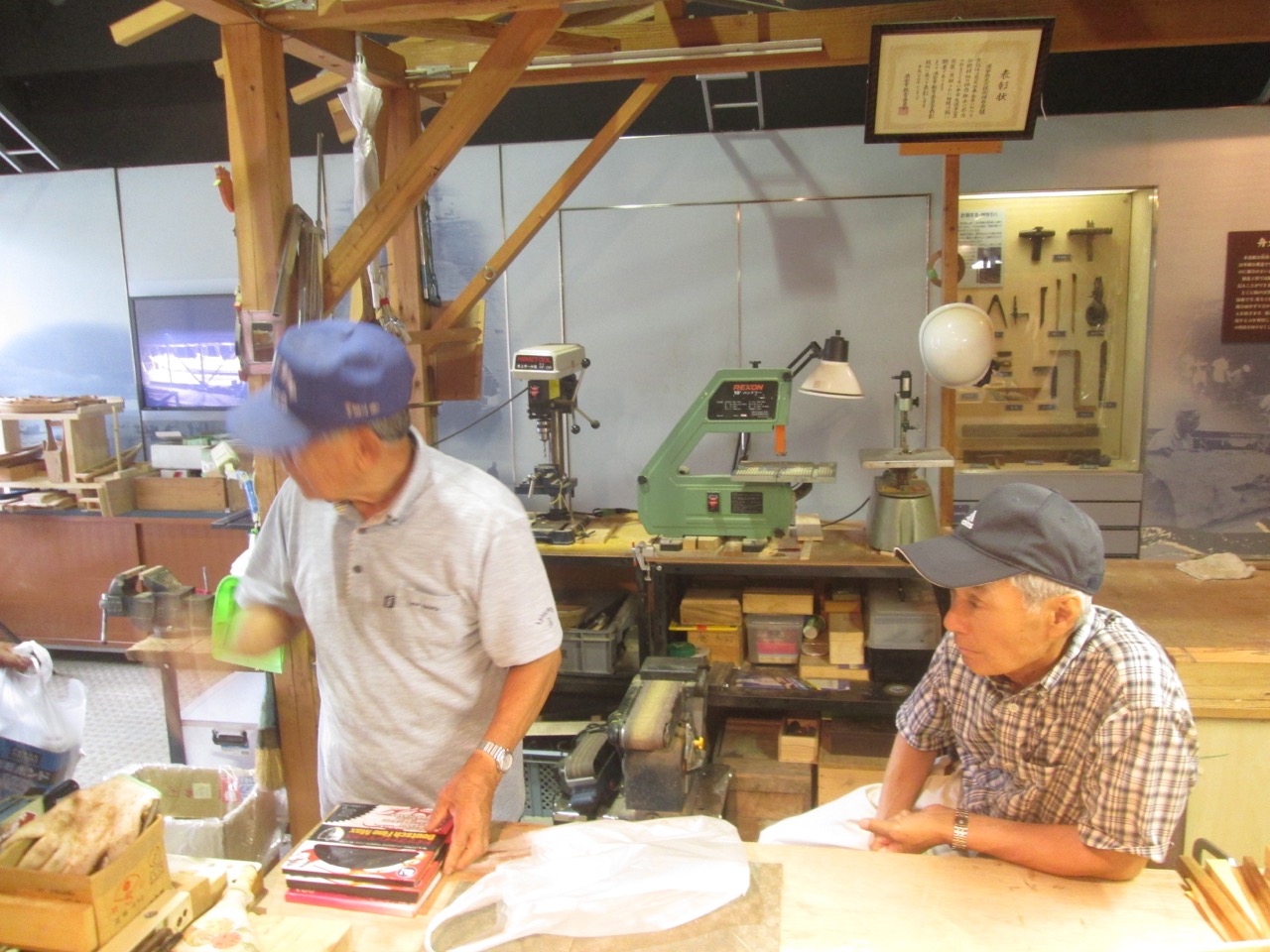
So, what do I find when I walk downstairs amongst the old boats? A workshop set up in the middle, with three old guys at benches surrounded by small band saw, drill press, sanders, racks of clamps, sheets and blocks of wood, etc., and they’re making model boats!

img_1653

An Urayasu bekabune similar to the one I’m trying to build.

img_1711 img_1710

Big language barrier here, more than is usual at a museum, but they’re all museum volunteers, and in the middle is the kind of gruff guy they pointed out as the “boss”. It was clear to me that this was kind of like the equivalent of the Hyde Street Pier Model Shipwrights.

img_1706

Now, these guys aren’t part of the Japanese ship model society called The Rope, that I’ve mentioned before. The boss is a former boat builder, and the others more or less appear to volunteer as his assistants. He actually has a full-sized boat building project going on there.

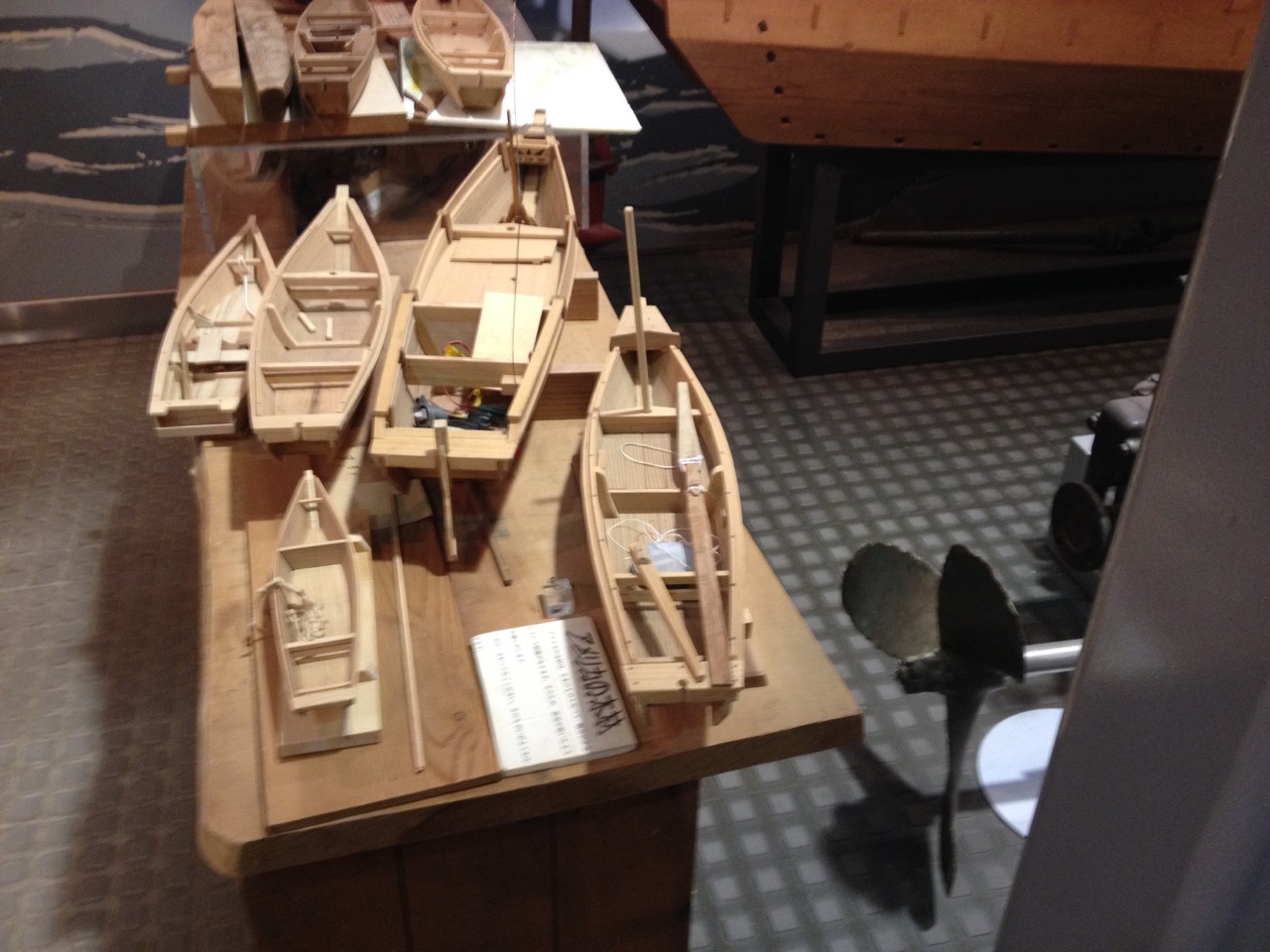
I wasn’t able to discern why they were building these models. They were actually kind of crude by ship modeller standards, but they were neat. They might be the kind of model you’d mass produce for museum shops, though there was no sign of anything like that. In one case, a larger model was clearly being set up for radio control.
img_2815

I finally ran across someone who actually worked there and he spoke some english, so we talked about the specific boats that the region was known for. The guy was kind of like their own Terry Dorman, our hard working volunteer coordinator with the Park Service, and he was dropping off some band saw blades that the builders needed.

I didn’t catch his job title, and I haven’t had a chance to translate the Japanese business card he gave me, but his name is Mr. Shimamura. Since I’m now modeling a bekabune, which is the boat type built and used in Urayasu, he showed me some details about them and gave me their museum pamphlets.

Unexpectedly, as we were heading towards the lobby, he left me for a minute and came back with a paper bag and motioned me to come outside. In front of the museum, he took one of the bekabune models that the volunteers built and handed it to me, saying “gift”. I was really taken aback, but grateful and thanked him very much.

In case you're wondering, it was 80˚+ with 87% humidity in Japan

In case you’re wondering, it was 80˚+ with 87% humidity in Japan

I had no idea how I’d take the 14″ long boat model back home with me, but I was expected I’d figure something out. As it turns out, I think this will be a great prop for my demo on Japanese boat modeling at the Nautical Research Guild conference next month. And, as it turns out, if I’m really careful, I can pack it quite comfortably in my luggage.

I could easily have spent another hour or two at the museum, but it was late in the day, and having received the gift from Mr. Shimamura, it seemed like a perfect end to the visit. I will definitely be coming back here again on another trip

– Clare Hess
Bay Area Ship Modelers’ Group Build – Amati’s Swedish Gunboat

Ship Modeler

It’s not enough that I belong to two long-standing Bay Area ship model clubs, the Hyde Street Pier Model Shipwrights and the South Bay Model Shipwrights, but a couple years back, I got together with a couple local people I met on the ship modeling forums and we started a quarterly get-together that mostly meets at the Naval and Historical Museum in Vallejo, California.

Recently, a couple of us discussed the merits of having us all, or at least a group of us, working on the same kit, but each person with his own model. The idea was that we could better discuss techniques and problem solving if we were all dealing with the same issues at, more or less, the same time.

Being that physical location of the ship model store and distributor Ages of Sail is pretty local to all of us, we decided to go with…

View original post 418 more words

Higaki Kaisen – Edo Period Transport Model by Clare Hess

Back in August, we published a post about the classic yacht model the Good News, built by Paul Reck. The post included a link to a nice slideshow Paul put together. Well, Clare Hess decided to do something similar for his Higaki Kaisen model.

DSC02491

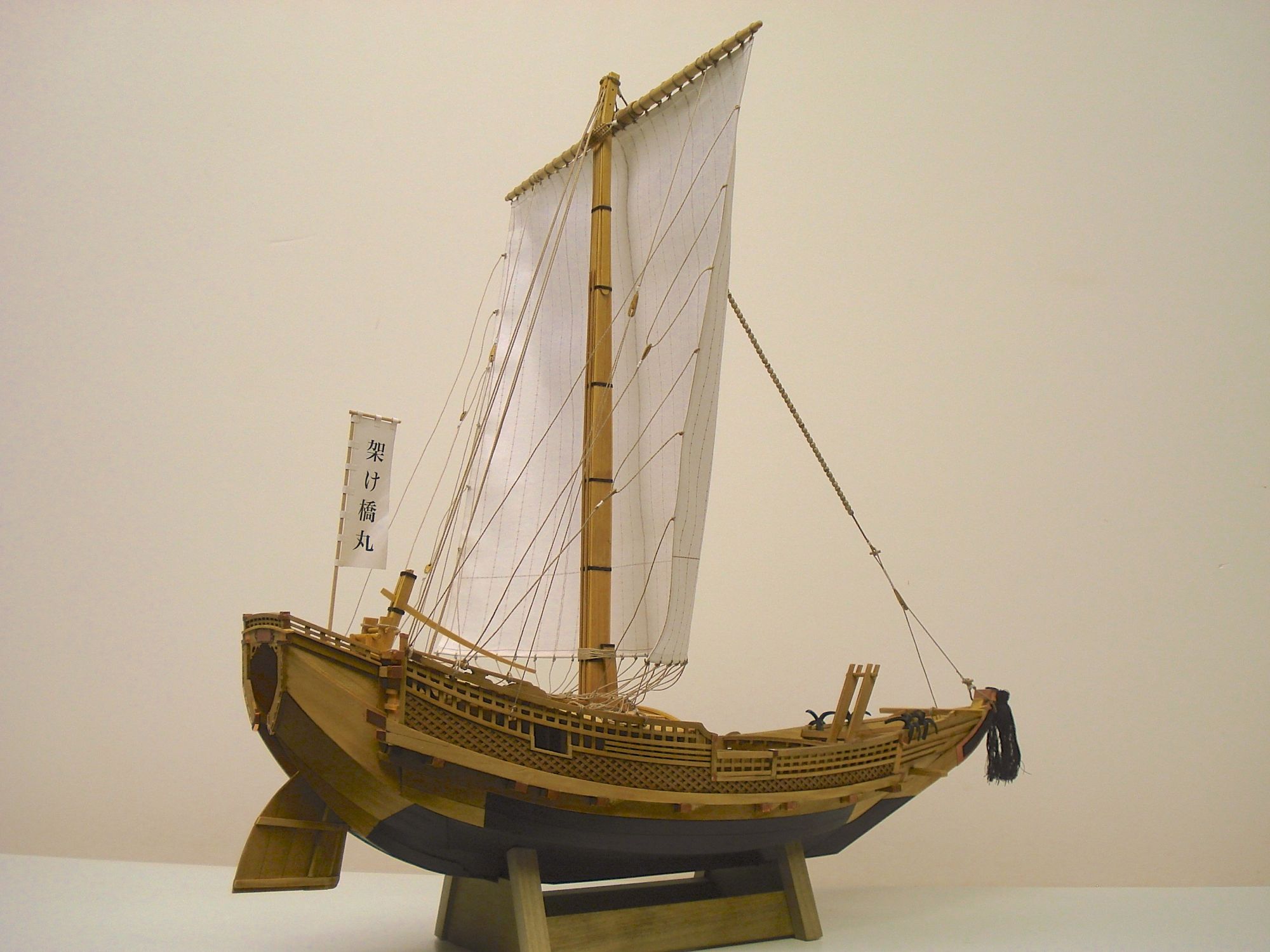
The model itself is built from a kit by the Japanese wooden model manufacturer Woody Joe. It measures about 16-1/2″ long and high and is made from a wood called Hinoki, which is an aromatic Japanese Cypress. The kit features a large number of laser-cut parts and includes some interior details in the cabin area. Some of the wooden panels have been omitted, so as to allow a view of the interior areas.

Building the model took a matter of just a few months due to the manufacturer’s heavy use of laser-cut parts and detailed instructions, plus the fact that these ships had very simple square sail rigs. Click here (link disabled as slideshow is not currently available) to view the slideshow showing the model going through the various stages of construction. Ω

Japanese Wasen Model Display in San Francisco

The latest Japanese boat model display by ship modeler Clare Hess is now on display at San Francisco’s Japan Center.

IMG_1856

The display is located in the window of the community room of Union Bank, which is in the East Mall building of the Japan Center Mall in San Francisco.

Three models are featured this time around, making for a much more complete display than the last two, which consisted of only two models. The models are shown below.

Higaki Kaisen – A Japanese coastal transport from the Edo Period. This sailing ship operated in vast numbers between Osaka and Edo (now Tokyo), maintaining the flow of consumer goods which supported the growing cities economy.

Higaki Kaisen

Hacchoro – An 8-oared fishing boat used by the fishermen of the Daizu region south of Mt. Fuji. This model features the family crest of the Tokugawa Shogunate because many of these boats were said to have been commissioned as guard boats for the retired Shogun Tokugawa Ieyasu. Special permission was said to have been granted for these boats to be equipped with 8 oars so that they could keep up with the Shogun’s boat. This is how these boats got their name, as Hacchoro literally translates as “8 oars.”

Hacchoro


Yakatabune – These houseboats were initially owned by nobility for leisure use, but were very popular during the peace and growing prosperity of the merchant class. During the Edo period, it became common to rent a yakatabune to entertain guests or for viewing the fireworks at festival time or cherry blossoms in the Spring. These boats became a cultural symbol of growing prosperity.

Yakatabune

The display runs now through the end of December, 2015. Ω

Ship Modeler

This week, I installed my latest display of models of traditional style Japanese boats at the Japan Center in San Francisco. If you haven’t seen it before and are in the area, this is a good display to check out. This time around, I added a third model to the collection, my Yakatabune model. So now, there is the Higaki Kaisen (1/72-scale), Hacchoro and Yakatabune models (both 1/24-scale). All three models were built from kits by Woody Joe of Japan.

The display will run from now through all of November and December in the window of the Union Bank community room, which is in the East Mall building.

IMG_1856

One thing I discovered while setting up the new display is that this is a much better time of year to display the models. Because of the lower angle of the sun, the there is far less glare from the skylight above, making…

View original post 124 more words

NRG’s 2015 Photographic Ship Model Contest

The Nautical Research Guild held their annual conference in Mystic, CT, at the end of October. While only one of our Hyde Street Pier Model Shipwrights members was able to attend to representing our group. At the NRG banquet, our group members took a larger share of the honors.

The winners of the 2015 Photographic Ship Model Contest were announced at the dinner event. All models entered into the contest received a ribbon based on total points earned in the scoring. The top models in the categories of Journeyman and Master received medals. Three medals, either Bronze, Silver or Gold, were awarded in each category, for a total of six medals, with Hyde Street Pier members taking home with 2 of the 6 medals.

Clare Hess, receive a Bronze medal in the Journeyman category for his model of the Private Armed Schooner Lively, 1813, while Paul Reck was awarded a Silver medal in the Journeyman category for his model of the Grand Banks 32, Willie II.

Clare’s Lively model is a 1:48-scale scratchbuilt model of a small, single gun privateer, typical of the early pilot boat model privateers of the War of 1812. The model was based on kit plans by the late Jim Roberts.

CIMG5320 CIMG5506 CIMG5286 CIMG5299


Paul Reck’s Willie II is a Grand Banks 32 that was built around 1978 and used by the St. Francis Yacht Club as a race committee boat. His model was built from scratch in 1:16-scale and is on display at the Yacht Club.

WLStewart-BowPortQuarter WLStewart-MidshipsAbeam WLStewart-SternPort WLStewart-UpperDeckDetail

Watch the upcoming NRG Journal and the NRG website for a full report on the contest.

Note: This story originally referenced the wrong yacht club for the Willie II. The correct yacht club is the St. Francis Yacht Club, not the Corinthian Yacht Club. Thanks to David Wingate for catching the slip-up!